Login

We use cookies to understand which experiences land. You can opt in or out — your choice.

Login
Cheltenham Regency architecture along the Promenade
Travel & CultureCheltenham

Things to Do in Cheltenham Beyond the Festival

Britain's most complete Regency town beyond the March racing: Promenade, Pittville, Montpellier.

HomeBlogThings to Do in Cheltenham Beyond the Festival
  1. A short history
  2. The Promenade and Montpellier
  3. Pittville and the Pump Room
  4. Eating in Cheltenham
  5. Drinking
  6. The four festivals
  7. Cheltenham Jazz Festival
  8. Cheltenham Science Festival
  9. Cheltenham Music Festival
  10. Cheltenham Literature Festival
  11. Day trips and the Cotswolds
  12. Practical notes
Sian Jones
Sian JonesSenior Event Manager
9 min read19 Mar 2026

Summary

Cheltenham is the most complete Regency town in Britain, sitting on the edge of the Cotswolds about a hundred miles west of London. Beyond the racing, the town is built around the Promenade, the Montpellier district and Pittville's pump room.

Four major festivals (Jazz, Science, Music, Literature) keep the town busy from April through October, and Cheltenham makes a natural base for a Cotswolds weekend.

Cheltenham is the largest town in Gloucestershire, sitting on the edge of the Cotswolds about a hundred miles west of London. Most visitors arrive for one of two reasons: the Cheltenham Festival in March or one of the four major arts festivals (Literature, Music, Jazz, Science) that run from April to October. Both reasons are worth the trip; neither captures what makes the town itself one of the most distinctive in England.

Cheltenham is, in short, the most complete Regency town in Britain. The buildings date from the late 18th and early 19th centuries when the place developed rapidly as a fashionable spa, drawing royalty and gentry to drink the mineral waters. The town has retained most of that Regency architecture. This is a guide to what to do in Cheltenham outside the racing weekends.

Cheltenham and the Cotswolds (a street lined with stone buildings next to a lush green forest)
Cheltenham and the Cotswolds (brown and gray house beside river under cloudy sky during daytime)
Cheltenham and the Cotswolds (brown concrete houses beside river)
Cheltenham and the Cotswolds (a street lined with stone buildings next to a forest)
Cheltenham and the Cotswolds (a street lined with trees and houses next to a forest)
Cheltenham is the most complete Regency town in Britain.

A short history

Cheltenham was a small market town until 1716, when a mineral spring was discovered in a meadow on the edge of the settlement. The healing-spring industry took off slowly across the eighteenth century. The watershed moment was King George III's visit in 1788, which set the social seal of approval on Cheltenham as a fashionable spa resort.

Over the following sixty years Cheltenham grew rapidly. Captain Henry Skillicorne, the first entrepreneur to commercialise the mineral spring, built the original pump room and walks. As Cheltenham's fame grew, developers built Regency terraces, classical pump rooms, formal gardens and the wide tree-lined avenues that define the town centre today. By the 1850s the town had reached the broad shape it still has.

The mineral-water spa business faded in the late Victorian era as spa-going went out of fashion. The town retained its Regency architecture through luck and conservation: Cheltenham did not industrialise like many neighbouring towns, the building stock was protected, and the wider Cotswolds setting kept tourism alive even when the mineral-water industry didn't.

The Promenade and Montpellier

The Promenade is the central avenue of Cheltenham: a long Regency boulevard lined with shops, restaurants and gardens, running from the Long Garden in the south to the Municipal Offices at the north end. The shops are a mix of independent British retailers (some of them century-old institutions) and the higher-end multiples. The Cavendish House department store is the town's most-recognised retail name; the rest of the Promenade is shop-front Regency on both sides.

Imperial Gardens, partway along the Promenade, are the formal Victorian flower gardens facing the Town Hall. They are at their best in summer, when the bedding plants and bandstand concerts make them the central park space of the town. The Town Hall hosts the Literature Festival in autumn and concerts year-round.

Montpellier sits just to the west of the Promenade and is the smartest district in town. The Montpellier Walk shopping street is a curved Regency parade with caryatid figures (carved female forms in the place of pillars) along the shopfronts. The cafés, restaurants and boutiques here are the more independent and design-led end of Cheltenham retail. The Montpellier Gardens behind the Walk are a small but well-maintained formal garden.

Pittville and the Pump Room

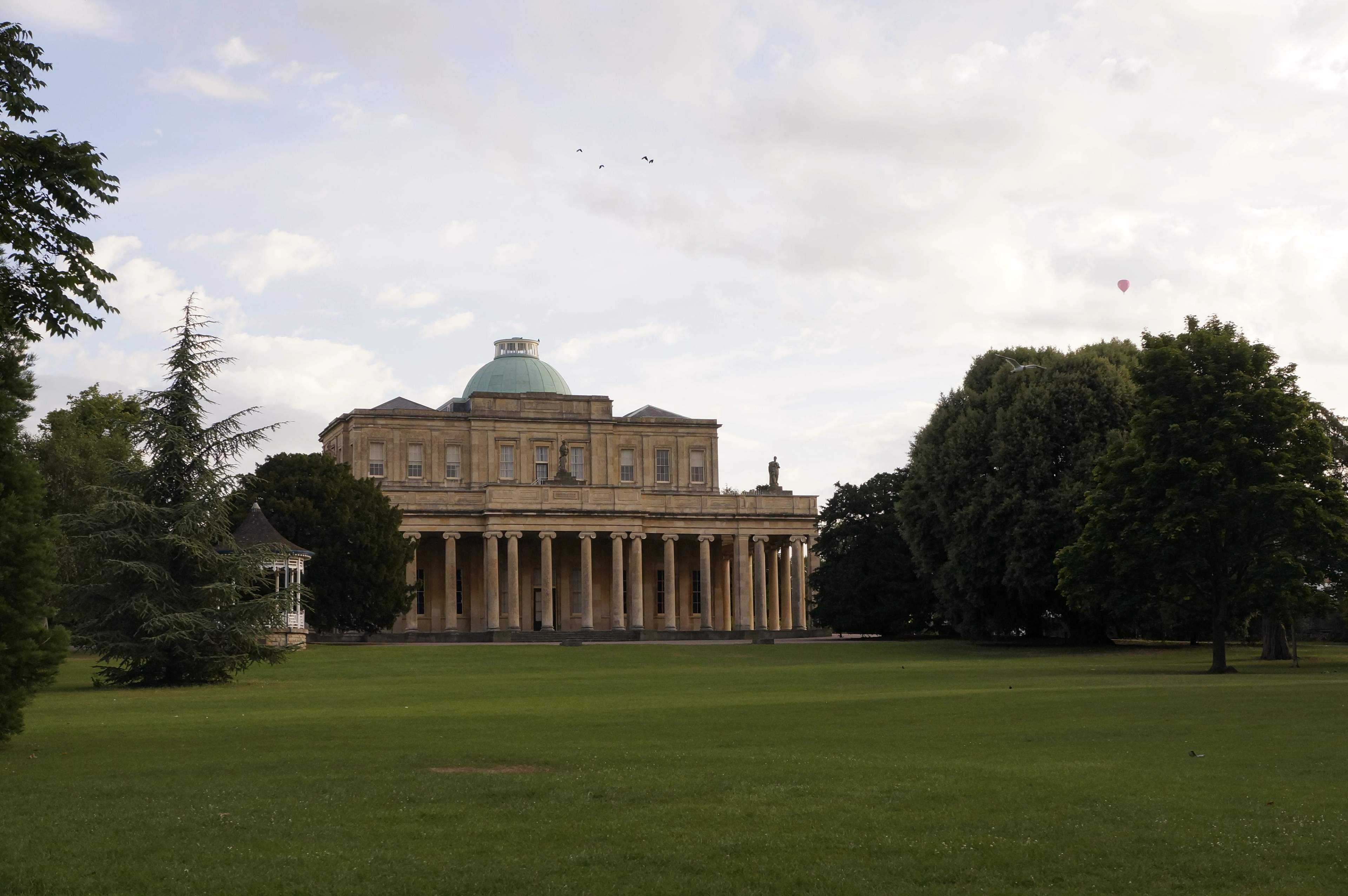
Pittville is the northern Regency extension of Cheltenham, planned in the 1820s as a new suburb and centred on the Pittville Pump Room. The Pump Room was completed in 1830 as the principal spa-water building of the new suburb; it remains the most architecturally accomplished building in Cheltenham today.

The Pump Room is open to the public most days. The mineral spring still runs (visitors can taste the water; the taste is described charitably as "distinctive"). The building hosts weddings, classical concerts and gatherings; the Pittville Park around it has a lake, a boating area, a children's playground and walking paths.

Pittville Park is connected to Cheltenham town centre by the Long Garden, a Regency formal garden corridor running south. The walk from Pittville Pump Room to the Promenade is about twenty minutes and runs through some of the most-photographed bits of the town.

Eating in Cheltenham

Cheltenham has a stronger restaurant scene than most British towns of its size, largely because of the racing weekends and the festivals. The town has consistently held Michelin recognition at a level well above its size. Le Champignon Sauvage in Suffolk Road is the town's longest-tenured Michelin restaurant. The Daffodil in Suffolk Parade is a converted 1920s cinema with theatrical interiors that suits a slightly dressed-up evening. The Bhoomi Kitchen on Suffolks is one of the country's most-praised Indian restaurants.

Around the festivals (especially the March racing) all the major restaurants book out months in advance. Outside the festivals the dining is easier; lunch in particular is a soft sell across the town's restaurants, and most of the better places offer affordable midweek lunches.

For a more casual evening, the Brewhouse and Kitchen on the Promenade brews its own beer and serves food. The Brewery Quarter, ten minutes' walk from the Promenade, has a cluster of bars and a cinema in a redeveloped Victorian brewery.

Drinking

The Cheltenham drinking culture skews more wine-and-cocktails than beer. The town has several smart cocktail bars in the Montpellier area, wine bars across the Suffolks, and a strong micropub scene for traditional ales.

The Brewery Quarter, a redeveloped Victorian brewery near the centre, has a cluster of bars, food outlets and a cinema in a single complex. It is the most-recommended single destination for an evening of multiple bars; the Brewery Quarter sits about ten minutes' walk from the Promenade.

The four festivals

Cheltenham runs four major festivals a year outside the racing. Each pulls a decent crowd and together they make Cheltenham one of the busier UK regional towns for cultural tourism.

Cheltenham Jazz Festival

Cheltenham Jazz Festival runs in late April / early May. The line-up is large, the venues span the Town Hall, jazz clubs, restaurants and outdoor stages, and the audience leans broad-based and informal.

Cheltenham Science Festival

Cheltenham Science Festival runs in early June. Talks, lectures, family days and laboratory open days run across the town for around a week. The festival is closely associated with the GCHQ presence in the town (Cheltenham is home to GCHQ, the UK signals-intelligence agency).

Cheltenham Music Festival

Cheltenham Music Festival, in late June/early July, is the chamber-music and classical-music festival, with concerts in churches, the Town Hall and the smaller venues around town.

Cheltenham Literature Festival

Cheltenham Literature Festival runs in early October. It is one of the largest literary festivals in Europe, with hundreds of author talks across ten days at the Town Hall and the Festival Site. The audience and the line-up are both substantial.

Day trips and the Cotswolds

Cheltenham sits on the edge of the Cotswolds and is a natural base for a Cotswolds weekend. The wider region has dozens of villages worth visiting; the ones within thirty minutes of Cheltenham are the obvious starting points.

Broadway (20 minutes north) is the picture-postcard Cotswolds village: honey-coloured stone, smart hotels, antique shops. Stow-on-the-Wold (30 minutes north) has a market square that has been the same shape since the seventeenth century. Bourton-on-the-Water (30 minutes north-east) has the Windrush stream running through the village centre and a model village.

Sudeley Castle (15 minutes north-east, near Winchcombe) is the burial place of Henry VIII's last wife, Catherine Parr, and has a private chapel and Tudor gardens. Tewkesbury (20 minutes north-west) has Tewkesbury Abbey, one of the great Romanesque churches of England. Gloucester Cathedral (15 minutes south) has the medieval cloister where the Harry Potter film series shot some of its Hogwarts scenes.

Beyond the immediate Cotswolds: Oxford (an hour east), Stratford-upon-Avon (an hour north-east), Bath (an hour and a quarter south-west). Each makes a comfortable day trip from a Cheltenham base.

Practical notes

Getting to Cheltenham: by train from London Paddington (around two and a quarter hours direct) or by car (around two and a half hours from London via the M4 and M5). The town's central area is walkable; the longer trips out to Pittville or to the Festival Site at the racecourse are about twenty minutes' walk.

Cheltenham has a small but well-developed taxi infrastructure for getting around the town and out to the racecourse. Most central hotels and restaurants are within walking distance of one another; a taxi to the racecourse takes around fifteen minutes from the centre.

Where to stay: the Promenade and the Montpellier district have the most central hotels (the Queens Hotel Cheltenham and Hotel du Vin Cheltenham). Country house hotels in the surrounding Cotswolds (Cowley Manor, twenty minutes south, and The Lygon Arms in Broadway, thirty minutes north-east) are within easy distance and offer a different kind of weekend.

Best time to visit: outside the Cheltenham Festival (mid-March) and outside the Literature Festival (early October), Cheltenham is a relatively quiet country town. May, June and September are the best months for the gardens and the weather. The four festivals each push the town's accommodation toward sold-out, so book well in advance for any of them.

Sian Jones

Sian Jones

Senior Event Manager

Senior Event Manager at Imperial Corporate Events, looking after the racing season and the country sporting calendar.

View profile
CheltenhamTravel GuideCotswolds

Related articles

View all articles
The Cheltenham Racecourse grandstand on a Festival race day
Horse Racing
Cheltenham FestivalHorse RacingHospitality

A Day at Cheltenham Festival

What a Cheltenham Festival day actually looks like, from the Roar to Gold Cup Friday.

5 min read13 Apr 2026
Race-day crowd at Cheltenham Racecourse
Horse Racing
Cheltenham FestivalDress CodeHorse Racing

Cheltenham Festival dress code: smart means tweed and mud

Cheltenham has no official dress code. The unwritten one: tweed, boots, a waxed jacket for rain.

4 min read08 May 2026

Get early access to the best experiences, straight to your inbox

By subscribing you agree to with our Privacy Policy.

Experiences

  • Sports
  • Entertainment
  • Food & Culture

Company

  • Blog
  • Client Portal
  • Careers
  • Respect Charter

Connect

  • Facebook
  • Instagram
  • LinkedIn
  • Youtube
  • (+44) 01162 695979
  • info@imperial.events

Copyright © 2026 Imperial Corporate Events Ltd. All rights reserved.

  • Privacy
  • Terms of Service
  • Cookies
Login
Login