Summary
Goodwood Revival is a three-day historic motor racing meeting, jump to The format at the original Goodwood Motor Circuit every September. The cars are race-prepared 1948 to 1966 competition vehicles, jump to The cars; the drivers race them seriously and damage to a million-pound Ferrari is part of the deal. Around the racing sit a Battle of Britain airfield, jump to Off-track attractions, period rock-and-roll, swing-dance floors and a Spitfire flypast.
Every September, an old Battle of Britain airfield in West Sussex spends three days pretending it is 1955, and commits to the act so completely that the petrol pumps are period and the chap waving you into the paddock is in a flat cap. Goodwood Revival is a historic motor race where the cars, the crowd, the marshals and even the signage are dressed to look as they did between 1948 and 1966. The 2026 meeting runs from Friday 18 to Sunday 20 September.
If a colleague has put your name down and you are quietly wondering what you have agreed to, here is the short version: it is part motor race, part fancy-dress party, and you do not need to care about cars to have a very good day. If you do care about cars, it is one of the best weekends in the calendar. The drivers race historic machines hard, and occasionally into each other; damage to a million-pound Ferrari is treated as the cost of doing business. The cafe serves spam fritters. Nobody is doing any of it ironically.

A short history of the circuit
From airfield to racetrack
The track is a wartime relic. It began as the perimeter road of RAF Westhampnett, a Battle of Britain airfield flown out of by RAF Tangmere's squadrons from 1940 to 1946. After the war the 9th Duke of Richmond and Gordon, a keen amateur racer, looked at that perimeter road and saw a circuit. The first meeting ran on 18 September 1948.
For the next eighteen years Goodwood was one of British motor racing's main stages: 2.367 miles around the old airfield, hosting non-championship Formula 1, the RAC Tourist Trophy and the great sportscars. Stirling Moss, Jim Clark, Graham Hill and Mike Hawthorn all won here.
The thirty-two-year silence
Then it stopped. By 1966 the cars had got fast enough that the owners were asked to add chicanes to slow them down. They declined, on the reasonable grounds that a chicane is an admission of defeat, and simply gave up top-flight racing rather than carve up the track. The circuit went quiet for thirty-two years.
It came back on 18 September 1998, fifty years to the day after that first meeting, and the Revival has run every September since. The only gap was 2020, when it became a closed-doors meeting called SpeedWeek, for reasons everyone now remembers.
The format: three days of racing
How the weekend works
Friday is practice and qualifying, and the one day the public can wander the paddocks freely. Saturday and Sunday are the racing: twelve to fifteen separate races across the two days.
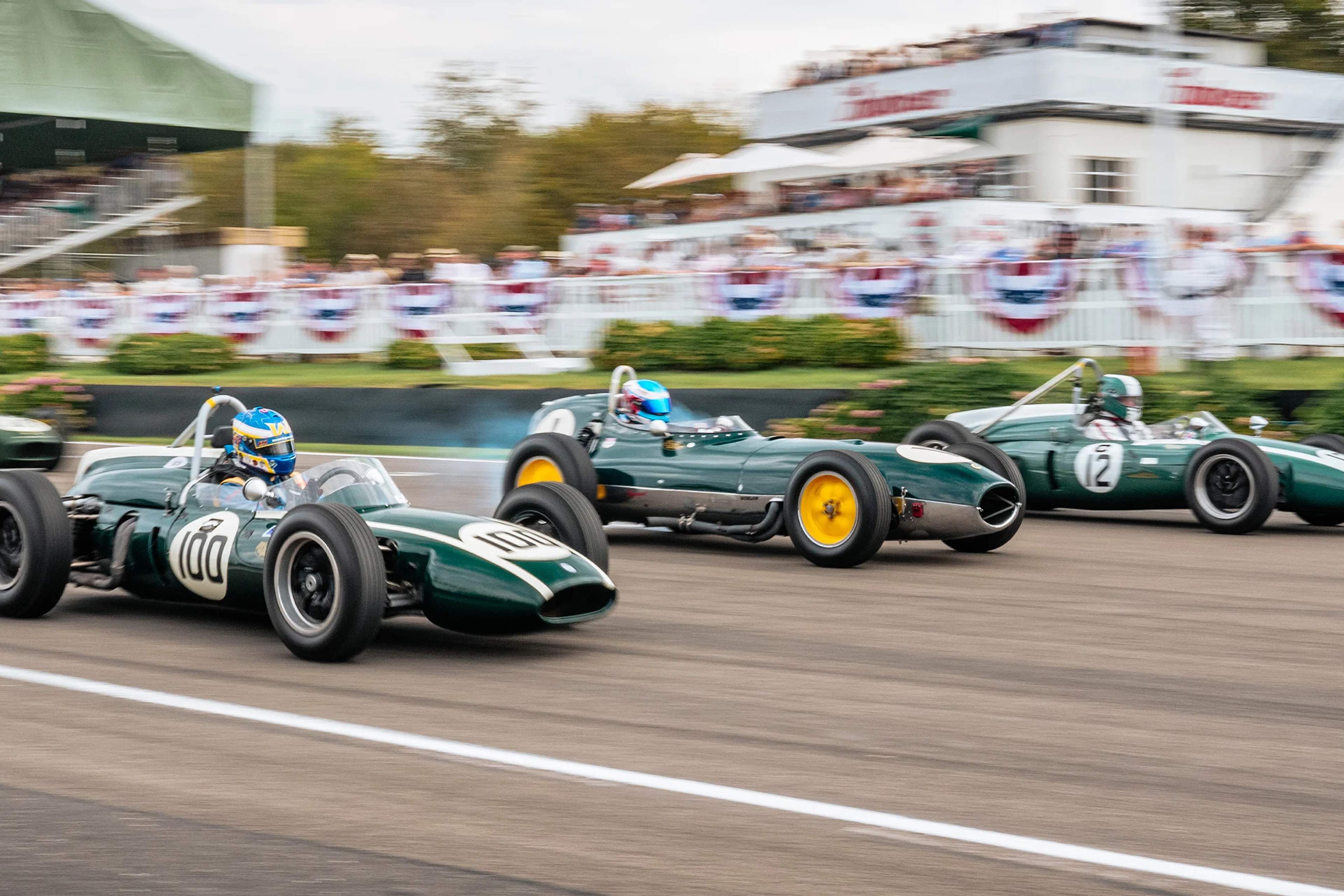
Each one is its own small world, a single class of period car, fifteen to thirty on the grid, six to twelve laps, done inside an hour. It is closer to a run of short sprints than a single Grand Prix, which suits a crowd that is also there to drink, dance and look at the frocks. You watch from the same grandstands and lawns the 1948 crowd used.
The canonical Revival trophies
Goodwood Trophy
Grand Prix and Voiturette cars from the 1930s and early 1950s, the weekend's pre-war single-seaters.
Glover Trophy
The 1.5-litre Grand Prix cars of the early 1960s, with Lotus, BRM, Cooper and Brabham going wheel to wheel.
Whitsun Trophy
The big 1960s sports-prototypes, the era of the Ford GT40, Lola T70 and McLaren M1A.
St Mary's Trophy
A period saloon-car race that alternates between 1950s and 1960s fields, pitting Mini Coopers and Lotus Cortinas against Ford Galaxies and Jaguar MkIIs.
Richmond and Gordon Trophies
The 2.5-litre Grand Prix cars of 1952 to 1960, where front-engined Maseratis and Ferraris meet the first mid-engined Coopers and Lotuses.
RAC TT Celebration
The weekend's headline race: a 60-minute, two-driver contest for early-1960s closed-cockpit GTs like the Ferrari 250 GTO, AC Cobra and Jaguar E-type.
Stirling Moss Memorial Trophy
Pre-1963 GT cars, from AC Cobras and Jaguar E-types to Aston Martin DB4 GTs and Ferrari 250 SWBs.
Settrington Cup
A pedal-car race for young children in vintage Austin J40 cars, run on the start-finish straight before the main programme on Saturday and Sunday.
The cars
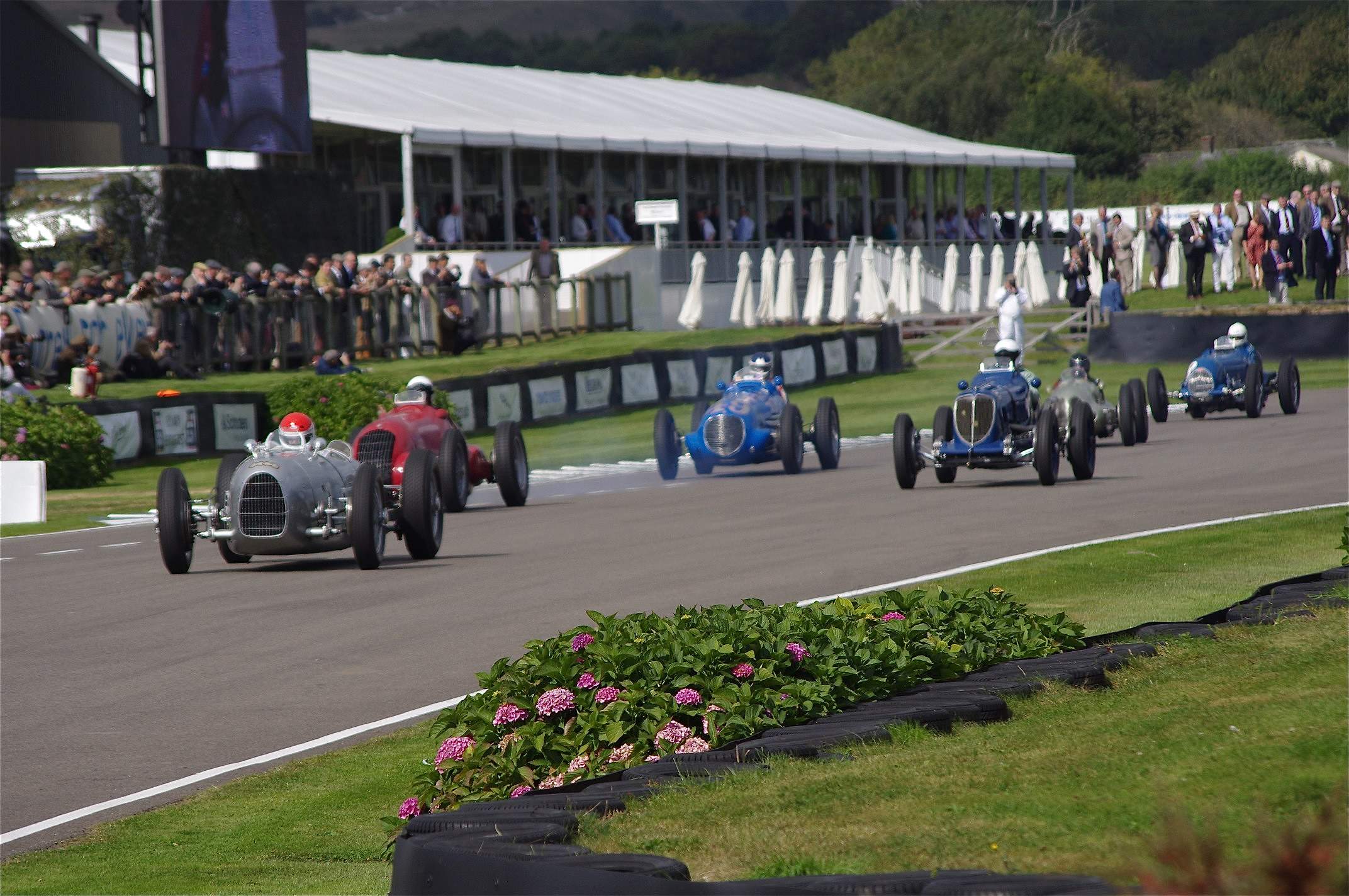
The rule for the grids is simple: every car has to be a genuine competition machine from 1948 to 1966, in race trim. This is not a concours, where cars are waxed and parked behind a rope. They are raced, hard, and now and then into the scenery. A Ferrari 250 GT SWB worth more than a house gets sideways through Madgwick like it owes someone money, and a few cars are written off every year. That is the point, not the mishap.
The range is enormous: pre-war Grand Prix cars, 1950s sportscars, early-sixties GTs, Mini Coopers and Lotus Cortinas from the saloon era. A St Mary's Trophy grid might have Cortinas and Galaxies barging past Jaguars; a Whitsun Trophy field might put a Ford GT40 against a Ferrari 330 P2.
The drivers are a mix of current and former professionals who come back for the love of it and gentleman amateurs who own the cars and race them all year. The standard is high enough that the racing is often closer than what you will see in a modern championship.
Off-track: the village, the airfield, the dance floor
The paddocks
The day splits between the circuit and the airfield inside it. The cars live between races in two paddocks, central and outer. The central paddock is the smart one, with its own dress code (jacket and tie for men, dress or suit for women), and it is the best place to stand if you actually want to see the machinery up close. It is also the part worth getting right, which is where we come in.
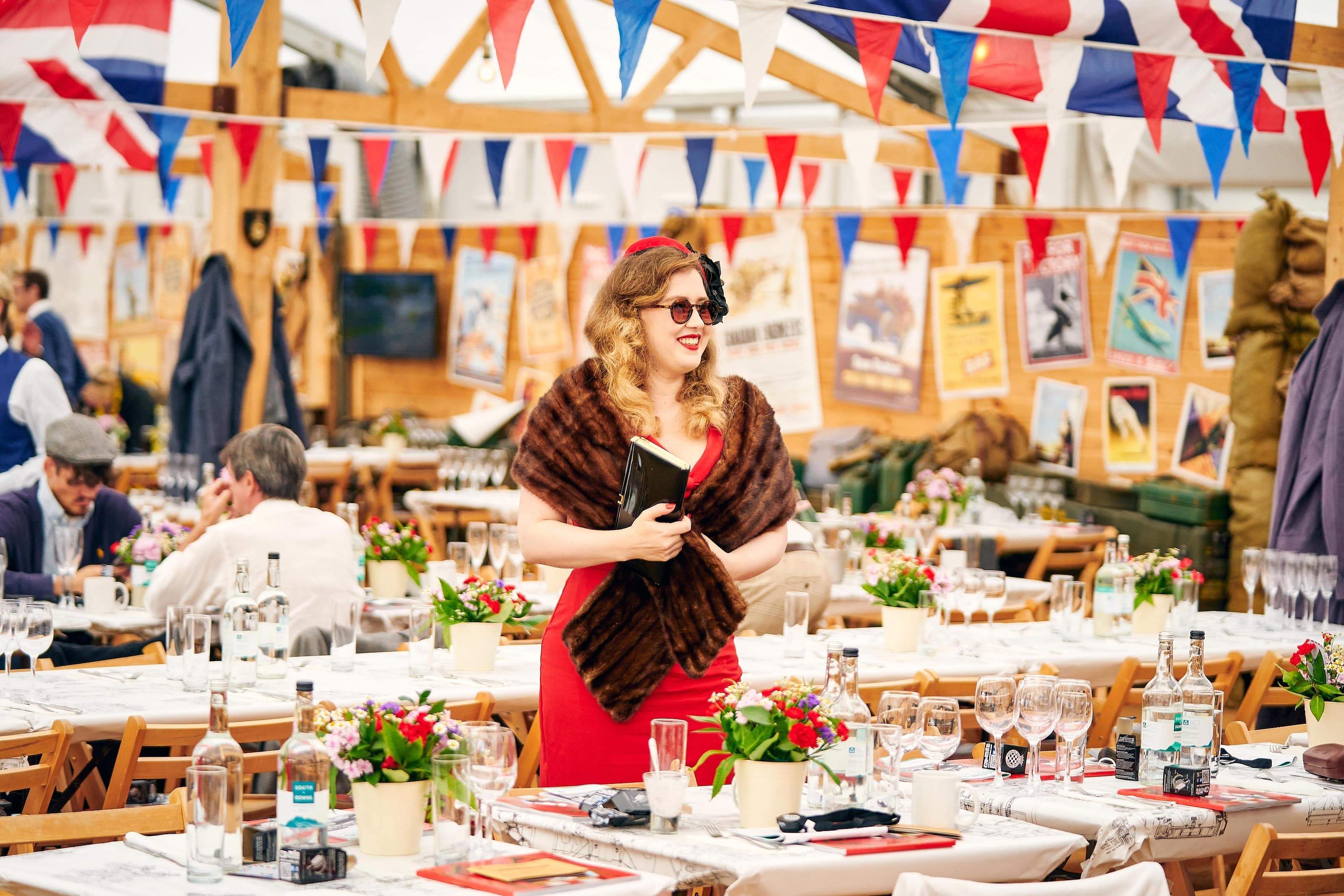
Around all that is the period stuff, and there is a lot of it: the Earls Court Motor Show recreated in a hangar with mid-century cars shown as they were when new, a Bonhams classic-car auction, a vintage funfair, and a drive-in cinema showing period films after dark. The children's Settrington Cup, raced in Austin J40 pedal cars down the pit straight, is the most photographed thirty seconds of the weekend.
Music, rides and aeroplanes
There is music all day: big band and jazz from the bandstand, rock and roll, jive and swing from the bars and pavilions. Vintage coaches shuttle you in from the car parks. Over the Road, the village outside the circuit, sells period clothes for anyone who turned up underdressed and felt it by mid-morning.
And there are the aeroplanes. A Spitfire or two will usually fly, sometimes a Hurricane, occasionally a Lancaster. Goodwood was a Battle of Britain airfield, and a Spitfire low over the same grass it flew from in 1940 lands rather differently to an air display anywhere else.
Who comes
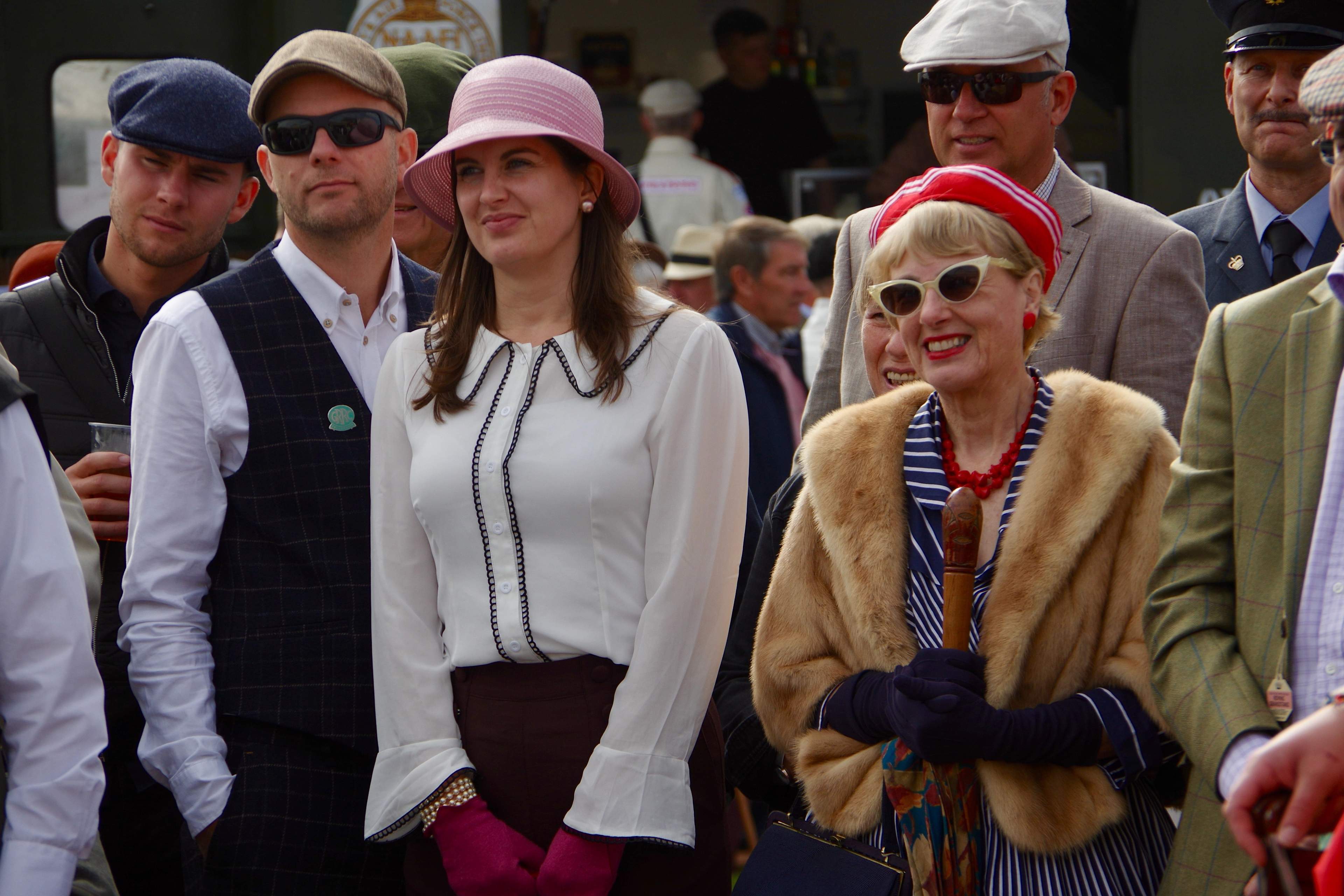
Two kinds of people go to the Revival. There are the ones who are there for the cars, who could skip the costume entirely and spend three days happily at the fence. And there are the ones there for the 1955 of it all, who would never need to see a lap as long as the swing band is playing and their seams are straight. The Revival is built for both, and the only real mistake is not knowing which one you are before you go.
The crowd skews older than a normal race meeting, though the under-30s turn out in force, mostly for the dressing-up. Serious racing fans stand next to the same country-sport set that does Henley in July. The famous faces tend to be drivers who came to race rather than be seen, and a fair number of the cars are owned and driven by the people you are standing beside in the paddock.
It is also, quietly, a children's weekend: the pedal-car Settrington Cup, the funfair, the cinema and the costume hire keep families busy across all three days.
Practical notes
The weather does what West Sussex does in September, which is anything from twelve degrees and wet to twenty-five and glorious, occasionally in one afternoon. Period dress copes with both if you layer it: tweed for the cold, cotton and a cardigan for the warm. Bring a coat that could pass for 1950s rather than a modern shell.
The single most useful thing for a first-timer: dress the part. Enough of the crowd is in costume that ordinary clothes make you feel like you have wandered onto a film set without a role. You do not need a full wardrobe to start. Hire an outfit for your first Revival, work out whether the whole thing is for you, and decide next year whether to commit. And if you would rather someone else sorted the where-to-stand and the smarter end of the paddock, that is the part we handle.

Sian Jones
Sport Events Operations Manager
Sport Events Operations Manager at Imperial Corporate Events. She’s the one on the ground making sure your day runs, from the Abu Dhabi Grand Prix to Royal Ascot.