Summary
The Calcutta Cup goes to the winner of England against Scotland in the Six Nations every year. It exists because a Calcutta rugby club, jump to How a Calcutta club ended up giving silver to Edinburgh folded in 1878, melted its last 270 silver rupees into a trophy and posted it to England. The first match, jump to The first match, and into the Six Nations was played in 1879, and it has been contested ever since. The dents in it are from a night out in 1988, jump to The 1988 trophy-dropping incident.
It is the oldest trophy in international rugby, and the only one that has been drop-kicked down Princes Street.
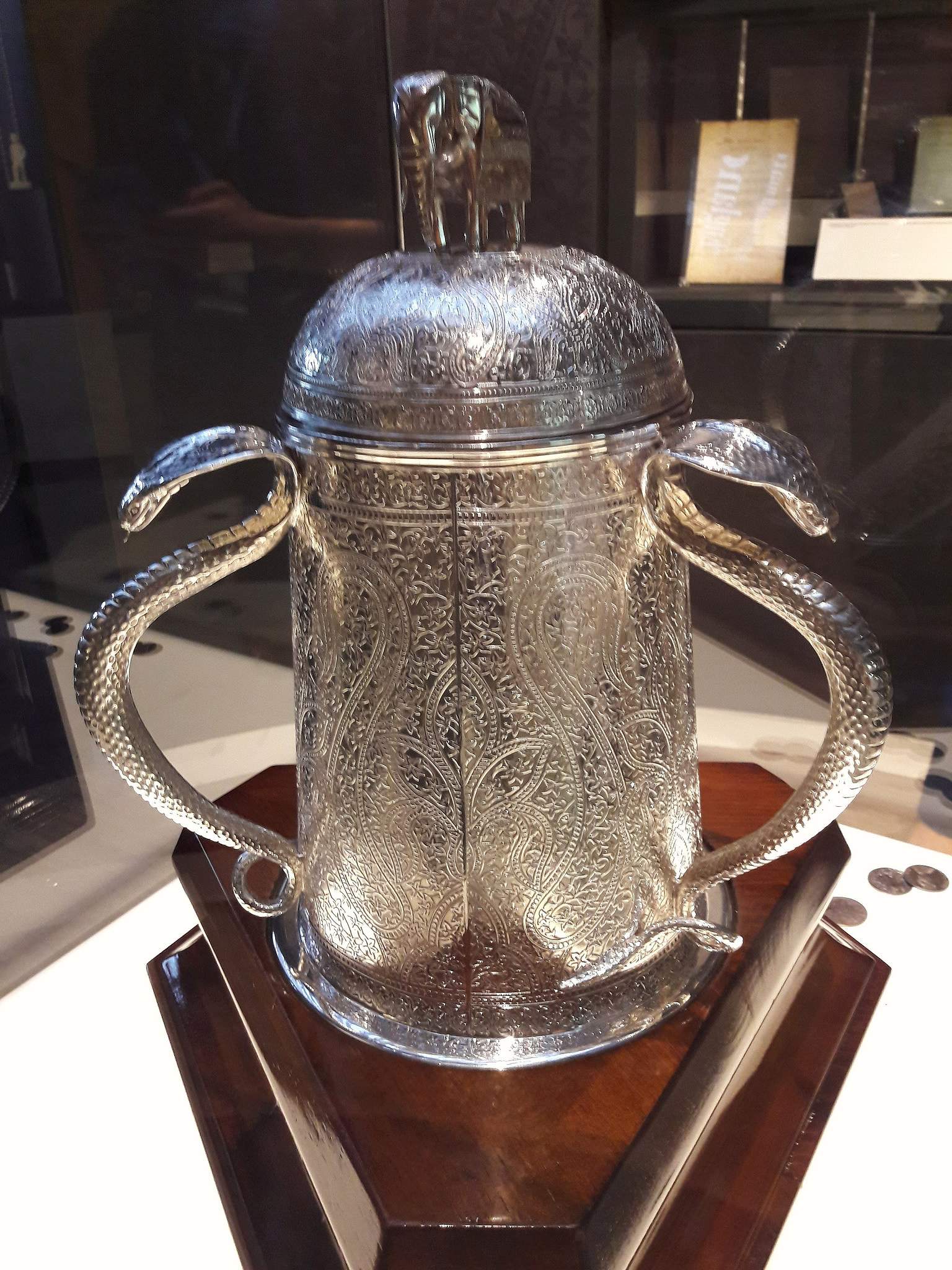
The Calcutta Cup is silver, about eighteen inches tall, with an elephant on the lid and three cobra-shaped handles, and it is one of the oldest trophies in any international sport. It is also, by some margin, the one that travelled furthest to become an institution, because it began life as the bank balance of a rugby club in Victorian Calcutta.
- 270 silver rupeesThe dissolving club's entire bank balance, melted down and turned into the trophy in 1878.
- An elephant and three cobrasIndian colonial silverwork, the elephant said to be copied from the Viceroy's own decorative stock.
- Contested since 1879Played for in the England-Scotland fixture every year since, now inside the Six Nations.
- The dents are realDrop-kicked down an Edinburgh street after the 1988 match. They never quite repaired it.
How a Calcutta club ended up giving silver to Edinburgh
Rugby reached colonial India early. The first recorded game in Calcutta was played on Christmas Day 1872 between British residents, and a formal club followed in January 1873, founded by old Rugby School boys and soldiers of the Royal East Kent Regiment. The Calcutta Football Club drew its players from the city's British expatriates, and for a few years it worked.
It did not last. By 1878 the membership had thinned, junior officers could not spare the time, and the small expatriate community could not sustain a competitive side. So the remaining members voted to wind the club up, and then made the decision that created the Cup: rather than simply bank the leftover funds, they withdrew the lot, 270 silver rupees, had a Calcutta silversmith melt them down, and commissioned a trophy to be played for each year. Then they posted it to the Rugby Football Union in England.
The trophy itself
It is a proper piece of Indian silverwork, around eighteen inches tall, the domed lid topped with an elephant said to be copied from the Viceroy's own silver, and the body engraved with the names of the very members who voted to dissolve the club. The Rugby Football Union technically owns it, but it moves between the two unions depending on who holds it. These days the original lives under glass and a replica does the travelling.
The first match, and into the Six Nations
The first Calcutta Cup match was played on 10 March 1879 at Raeburn Place in Edinburgh, and ended, fittingly for a fixture this stubborn, in a draw. The two unions agreed to contest it every year from then on, the winner taking custody for the season. When the Home Nations Championship formed in 1883 the Cup folded into the wider calendar without losing its own identity, and it has stayed that way through the additions of France in 1910 and Italy in 2000.
Inside the modern Six Nations it is a side-bet riding on a single fixture. You can win the championship without winning the Cup, or lose the championship badly and still carry it home, and both unions care about it either way. England leads the long head-to-head, though Scotland has had the better of recent years under Gregor Townsend.
The 1988 trophy-dropping incident
The strangest chapter came in 1988. England and Scotland had drawn 9-9 at Murrayfield, the players moved on to the post-match dinner and then to the bars of the Royal Mile, and two of them, John Jeffrey of Scotland and Dean Richards of England, took the Cup along for the evening.
By various accounts it was drop-kicked down Princes Street, briefly set alight, used as a pint pot, and finally retrieved from the pavement by the police. The damage was real: the elephant bent, the base dented, the surface scratched. It was repaired, but the marks are still there. Jeffrey got a six-month ban from the Scottish union and Richards a single match from the English one, an asymmetry that still rankles north of the border. Ever since, the original stays behind glass and a replica takes the field.
A few matches that mattered
For all the history, two games define it in modern memory. In 1990 England came to Murrayfield needing a win for the Grand Slam, and David Sole walked his Scotland side out at deliberate walking pace, the crowd singing Flower of Scotland in full voice, before Scotland won 13-7 and took the Slam themselves. In 2018 Scotland finally beat England again after a decade, and in 2021 they won at Twickenham for the first time since 1983. The Cup tends to produce that kind of afternoon.
Why it matters
The Calcutta Cup is essentially a happy accident. A small club that should have quietly vanished in 1878 instead turned its last few hundred coins into the oldest trophy in international rugby, and England and Scotland have now played for it more than 140 times. The 270 melted rupees are still in circulation, after a fashion, every spring.
The England-Scotland weekend, whether it falls at Twickenham or Murrayfield, is one of the great days in the rugby calendar, and arranging it around you is the sort of thing we do.

Emma Harrod
Managing Director of Leicester Sales
Managing Director of Leicester Sales at Imperial Corporate Events. She gets to know what suits you, then makes the day happen without the fuss.