
Summary
Club Members are back on the grass within two days of the final, jump to After the final. The renovation starts soon after: the most-used courts are steamed and resown, jump to The renovation, and by late September all 38 grass courts have been renovated to some degree. The grass grows through winter at 13mm and comes down to the playing height of 8mm from March. The bounce depends more on the soil, jump to Ryegrass and 8mm than on the grass.
The grass courts at the All England Club are back in use within two days of the final. Club Members play on them through the rest of the summer, and three smaller tournaments use the practice courts. Then the renovation begins, and by late September every grass court at the Club has had some degree of renovation for the following summer.
The work falls to a team of around 30 full-time and seasonal groundstaff. Neil Stubley is the Club's head of courts and horticulture. “As one Championships ends, the next one begins,” he says.
Who plays on the courts after the final?
The All England Club is a private members' club, and its grass courts are in play for Members from May to September. The groundstaff allow themselves a later start on the Monday after the final, at 8am instead of 7.30am. By Tuesday afternoon, several courts have been cut, marked out and handed back to Members. Will Brierley, a senior groundsperson, puts the gap between the last champion and the first Member back on court at “just a day and a half”.
The practice courts host three more tournaments. The Inter Services tournament is for the armed services. Play Your Way to Wimbledon is a national grassroots competition run by the Club and the Lawn Tennis Association (LTA), the governing body for British tennis. The British Masters is a tournament for veteran players.
Centre Court is kept for The Championships, like the other Show Courts. The Show Courts are the main stadium courts. The Club's Chair, Deborah Jevans, is the one exception. She hosts a day of tennis on Centre Court after the final, before its grass comes up.
What happens in the renovation?
The renovation starts on the Show Courts. The groundstaff water them heavily to soften the soil. Then they aerate them, punching holes in the surface with ride-on and hand-pushed machines.
Next comes the steam. Water is heated to 200°C in a boiler, and the steam is piped into the court under a tarpaulin tunnel. It is held there for 30 minutes to an hour. The heat kills weed grasses and diseases in the soil, so each court starts the year with clean ground.
After the steam, the old surface is either taken off completely and the soil relevelled, or scarified. Scarifying means raking the surface deeply to pull out dead plant matter. Then the court is sown with new seed. It takes about two weeks from the start of the steaming to new green grass, and the heat left in the soil helps the seed germinate.
Not every court gets the same treatment every year. During The Championships, the Sports Turf Research Institute collects data on how each court performs, and that data decides how much work each one needs. In 2025 the groundstaff steamed 16 of the 18 Championship courts. The plan from now on is to steam the six Show Courts every year, plus one block of four numbered outside courts, such as Courts 4 to 7.
By late September, all 38 grass courts have been renovated to some degree. That is 18 Championship courts, the ones used for matches during The Championships, and 20 practice courts. The Club uses nine tonnes of grass seed a year. At the end of the summer, each court also gets six tonnes of soil to keep its surface level.
Brierley says the autumn renovation determines the rest of the year. If it goes well, the work through the winter and spring is easier.
Why ryegrass, and why 8mm?
Every court is sown with 100% perennial ryegrass. The Club switched to it in 2001, after research by the Sports Turf Research Institute in Yorkshire. Before that, the mix was 70% ryegrass and 30% creeping red fescue. The research found that ryegrass would stand up better to wear without changing how fast the courts seem to play.
The grass is cut to 8mm for The Championships. The Club has used that height since 1995, and its research shows it is the best balance between how the court plays and how well the grass survives.
The bounce comes mostly from the soil, not the grass. The soil has to be hard and dry to take two weeks of play without damage underneath. That is why the courts are rolled and covered before The Championships, and why their water is cut back in June. The weather plays its part too. The ball feels heavier and slower on a cold and damp day. On a warm and dry day, it feels lighter and faster.
During The Championships, the groundstaff measure court wear, surface hardness and the rebound of the ball every day.
Why does the grass look worn by the second week?
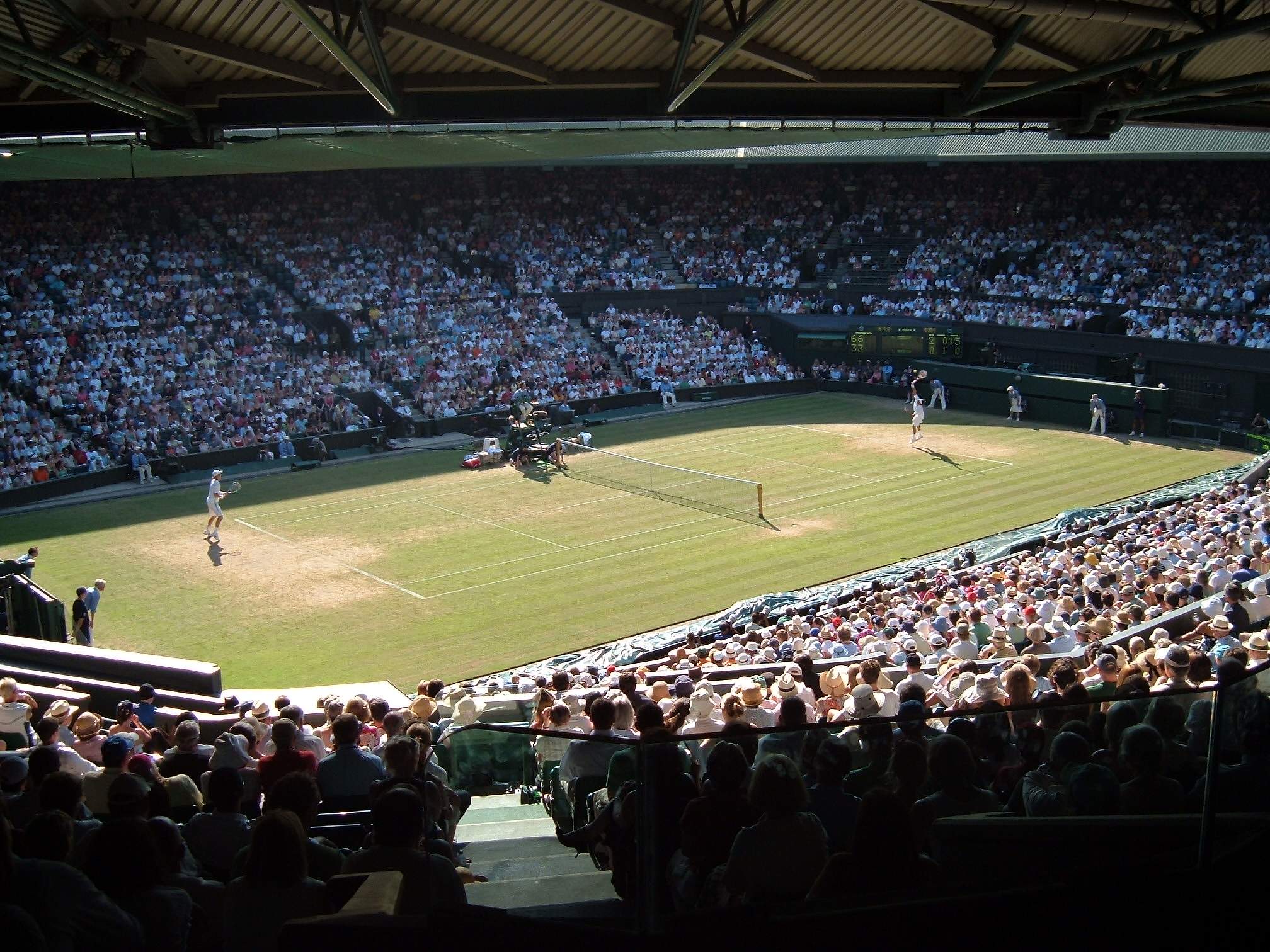
The courts are at their greenest on the first day. By the second week, the grass behind each baseline has usually worn down to bare soil, because that is where the players stand for most of each rally. Much less of the play happens near the net, so the grass there stays green.
The groundstaff cut and mark every court each day during The Championships. They also give the courts a little water each night to keep the grass alive, without softening the soil underneath.
What happens to the grass over winter?
Through the winter, the grass is kept at 13mm. Winters in south-west London have become warmer and wetter, so the team may still be mowing two or three times a week in December. The last significant snowfall Brierley remembers at the Club was in 2010.
From March, the cut comes down gradually from 13mm to the playing height of 8mm. The courts are ready for the Members' first day on grass in May. The white lines go on in early May, and the courts are rolled once a week that month with a one-tonne roller. In June, the watering is reduced to firm up the surface.
A new court, sown from scratch, takes around 15 months to reach Championships standard.
Seeing the grass from Centre Court
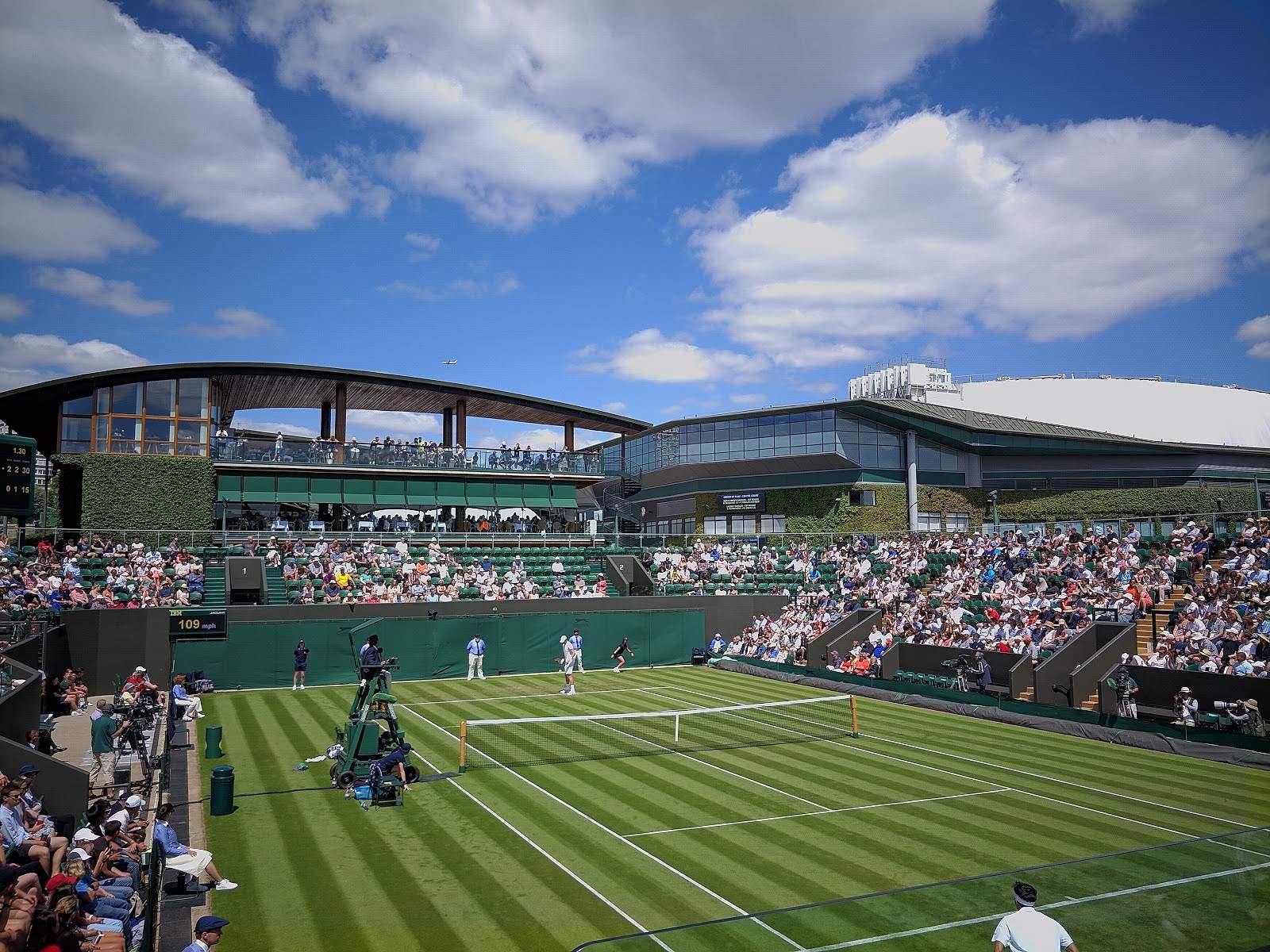
Centre Court and No.1 Court each have a grass area of 41 metres by 22 metres. We arrange debenture seats on both courts for every day of the 2027 Championships. A debenture is issued by the All England Club to raise money for the grounds, and it carries a reserved seat for The Championships. Each seat we arrange is for a named day, so your group knows exactly which day and which court it has, well before the summer.
Centre Court suits guests who want the biggest matches of each day, and it hosts both singles finals. No.1 Court is the second-largest show court, and it has its own roof, so play there continues in the rain.
The first days suit guests who want to see the grass at its freshest, before any wear shows. The second week and the finals weekend suit guests who want the biggest matches, and those are the days that go first.
Three more questions about the courts
How many courts are there at Wimbledon?
The All England Club has 38 grass courts. Eighteen of them are Championship courts, the ones used for matches during The Championships. The other 20 are practice courts. On top of the grass there are eight American clay courts and an indoor tennis centre, all in use through the rest of the year.
Are the lines at Wimbledon painted?
No. The lines are a white compound containing titanium dioxide, which makes them last. It is applied with a transfer wheel marker, and the Club uses about 500 gallons a year. Every line is 50mm wide, except the baselines, which are 100mm.
Does the All England Club only have grass courts?
No. As well as its 38 grass courts, it has eight American clay courts and an indoor tennis centre. American clay is a slower surface than grass. Apart from the grass, the Club's courts are used all year round by Members and by players sponsored by the LTA.

Chloe Burchell
Event Manager
Event Manager at Imperial Corporate Events. She’s hosted clients at everything from the Six Nations to the Eastern & Oriental Express, and she’s good company on the day.